People
Eddie Murphy Net Worth: Stand-Up Comedy to Hollywood Millions

Eddie Murphy’s net worth is estimated at $200 million in 2026, according to Celebrity Net Worth. The figure has never been confirmed by Murphy through a public financial statement, but his career offers plenty of evidence of how he became one of Hollywood’s highest-paid comedy stars.
From Saturday Night Live to Beverly Hills Cop, Coming to America and Shrek, Murphy built a career that made him one of Hollywood’s most recognizable comedy stars.
There was a time when he was earning a few thousand dollars per television episode. By the height of his movie career, he was negotiating deals worth millions. Yet one of the most revealing stories about Murphy’s career involves a film he never made.
In 2025, he explained that he had turned down Rush Hour, the buddy comedy that eventually starred Jackie Chan and Chris Tucker. Instead, Murphy chose Holy Man, a film that offered the appealing prospect of working in Miami. Looking back, he admitted the decision had not worked out particularly well.
For an actor with a career filled with successful films, even the opportunities he passed up have become part of Hollywood history.
Where Eddie Murphy’s $200 Million Estimate Comes From
Celebrity Net Worth places Murphy’s fortune at $200 million, a number also cited by Parade and Biography. But those publications are not necessarily providing separate valuations. They largely rely on the same celebrity-wealth estimate.
The actual amount remains private. There is no publicly available accounting of Murphy’s investments, real estate holdings, outstanding debts or contractual royalties that independently establishes his precise net worth.
What is better documented is the scale of his professional success. He became one of the industry’s most bankable performers during the 1980s and 1990s, earning substantial salaries and, in some cases, negotiating additional compensation tied to movie performance.
His financial position was built over decades, not from a single blockbuster or unusually lucrative contract.
Saturday Night Live Made Him Famous Before He Turned 21


Eddie Murphy attending the Saturday Night Live 40th Anniversary red carpet event in New York City in February 2015. Photo: Anthony Quintano / Wikimedia Commons, CC BY 2.0.
Murphy was born in Brooklyn, New York, on April 3, 1961. He began performing stand-up comedy as a teenager, developing impressions, characters and a distinctive stage presence.
His breakthrough came in 1980 when he joined NBC’s Saturday Night Live at just 19.
The show was experiencing a difficult transitional period after the departure of several original cast members. Murphy quickly emerged as one of its biggest attractions.
His characters, including Gumby, Buckwheat and Mr. Robinson, became audience favorites. He could transform familiar television personalities into comedy that felt unpredictable and unmistakably his own.
Celebrity Net Worth reports that Murphy earned approximately $4,500 per episode in 1981, with his pay later rising to a reported $30,000 per episode. These figures have not been confirmed through publicly available NBC contracts, so they should be treated as reported salary estimates.
The money was significant for a young comedian, but the greater reward was visibility. Television introduced him to millions of viewers and gave filmmakers a reason to take him seriously as a leading man.
Beverly Hills Cop Changed His Hollywood Earnings
Murphy’s first major film was 48 Hrs., the 1982 action comedy in which he starred opposite Nick Nolte. His performance announced that the energy audiences loved on television could also work on the big screen.
Trading Places followed in 1983, pairing Murphy with Dan Aykroyd. Then came Beverly Hills Cop in 1984.
Playing Axel Foley, a Detroit detective investigating a murder in Beverly Hills, Murphy found a character ideally suited to his strengths. Foley was sharp, funny, observant and remarkably good at talking his way through situations that should have ended badly.
The film became an enormous commercial success. It also established Murphy as a movie star capable of carrying a major studio production.
His financial leverage grew accordingly. Reported movie compensation climbed from comparatively modest early-career payments to multimillion-dollar deals.
Contemporary reporting by the Los Angeles Times placed Murphy’s salary for Beverly Hills Cop III at approximately $15 million, reflecting the negotiating power he had developed as a major Hollywood star.
That was a very different position from the teenager who had joined Saturday Night Live fourteen years earlier.
Coming to America Proved His Comedy Could Travel
In 1988, Murphy starred in Coming to America as Prince Akeem, a wealthy African royal who travels to New York in search of a woman who will love him for himself rather than his status.
The premise offered a perfect opportunity for Murphy’s mixture of confidence, physical comedy and character work. Alongside Arsenio Hall, he played additional characters hidden beneath elaborate makeup.
The film became one of his signature successes and remained popular long after its original theatrical release.
For Murphy, it demonstrated that he was more than a comedian who could make audiences laugh with a quick joke. He could build a fictional world around a character and make viewers want to return to it.
That enduring appeal helped bring him back to the role more than three decades later in Coming 2 America, released through Amazon Prime Video in 2021.
The sequel was also a reminder that familiar film characters can retain considerable commercial value in the streaming era.
The Nutty Professor Showed the Value of Playing More Than One Character

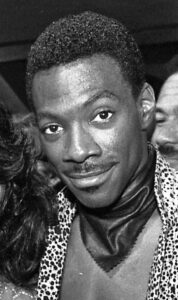
Eddie Murphy photographed in 1984, the year Beverly Hills Cop established him as a major Hollywood star. Photo: Ellen Jaskol / Wikimedia Commons, CC BY 4.0. Extracted from a larger original photograph.
Murphy had already demonstrated his love of disguises in Coming to America, but The Nutty Professor took that idea much further.
In the 1996 comedy, he played Sherman Klump, an intelligent and gentle professor who experiments with a weight-loss formula. Murphy also portrayed several other members of the Klump family, using makeup, voices and physical performances to give each character a distinct personality.
The film was a major success and led to Nutty Professor II: The Klumps in 2000.
Celebrity Net Worth claims that Murphy’s compensation for the sequel, including a reported $20 million upfront salary and additional participation, eventually exceeded $60 million.
That total should be treated as an entertainment-industry estimate, not an independently verified payment. Still, it illustrates the kind of financial arrangements Murphy was reportedly able to command at the height of his commercial power.
By that stage, studios were paying not merely for his appearance in a film but for the audience they believed his name could attract.
Shrek Introduced Eddie Murphy to Another Generation
When Shrek arrived in 2001, Murphy was already a familiar name to moviegoers. But his performance as Donkey introduced him to an entirely different audience.
The character was talkative, excitable and endlessly optimistic, often providing the humor while Mike Myers’ Shrek tried to escape the conversation.
Murphy’s voice became inseparable from Donkey’s personality. Children who had never seen 48 Hrs. or Beverly Hills Cop recognized him through the animated character.
The franchise went on to become a major commercial property, with sequels, merchandise and lasting popularity.
Murphy also voiced Mushu in Disney’s Mulan, further demonstrating how his comic delivery could translate into animation without requiring him to appear on screen.
His exact lifetime earnings from these voice roles have not been publicly established. What is clear is that animation helped extend his appeal beyond the audience that originally discovered him through stand-up comedy.
The Reported $70 Million Netflix Deal Was Never Confirmed
In July 2019, TMZ reported that Murphy was discussing a possible agreement with Netflix for stand-up specials, with negotiations said to be around $70 million.
The headline attracted attention because Murphy had spent years away from regular stand-up performances. A return to the stage would reconnect him with the form of comedy that first made him famous.
However, the reported amount was not a confirmed payment. TMZ acknowledged that it could not firmly verify the figure, and neither Murphy nor Netflix publicly established that he received $70 million for the proposed specials.
The distinction matters when calculating his wealth. A rumored negotiation is not the same thing as an executed contract, and an announced project does not establish how much an entertainer personally earned.
Murphy nevertheless continued developing a relationship with streaming audiences through films and other projects, making his career relevant in an industry that had changed considerably since the 1980s.
Dolemite Is My Name Reminded Audiences of His Acting Talent
Murphy’s career had experienced its share of disappointments, including movies that failed to match the commercial success of his earlier work.
Then came Dolemite Is My Name in 2019.
The Netflix film featured Murphy as Rudy Ray Moore, the comedian and performer who created the outrageous Dolemite persona and helped develop a distinctive form of independent entertainment.
Rather than simply revisiting one of his old characters, Murphy portrayed another entertainer’s determination to succeed.
The performance earned renewed critical attention and a Golden Globe nomination.
It was a different kind of achievement from selling millions of movie tickets. The acclaim showed that Murphy could still surprise audiences after decades in the business.
He had already demonstrated his dramatic abilities in Dreamgirls, earning an Academy Award nomination for his supporting performance as James “Thunder” Early.
Together, those roles offered a reminder that his success was never limited to delivering punchlines.
Hollywood Honored His Career in 2026
On April 18, 2026, Murphy received the American Film Institute’s 51st Life Achievement Award at the Dolby Theatre in Hollywood.
The event brought together performers including Dave Chappelle, Chris Rock, Martin Lawrence, Kevin Hart and Arsenio Hall, reflecting Murphy’s influence on generations of comedians.
The ceremony celebrated a career that had moved through stand-up, television, theatrical films, animation and streaming entertainment.
The tribute was subsequently presented to audiences through Netflix.
Murphy’s more recent work has included Beverly Hills Cop: Axel F, The Pickup and the documentary Being Eddie. Rather than disappearing from popular culture, he has continued working while audiences revisit the movies that first established his reputation.
The AFI award did not reveal anything about his bank accounts, but it confirmed something arguably more significant: his place in American entertainment history.
Conclusion
Eddie Murphy’s estimated $200 million net worth reflects one of Hollywood comedy’s most successful careers, though the exact figure remains unverified.
He began performing in comedy clubs, became a television star before turning 21 and developed into an actor whose movies could command enormous audiences. Along the way, he played a streetwise detective, an African prince, an entire family of characters and an animated donkey that millions of children came to love.
The financial rewards were substantial, but his career was never a straight line of uninterrupted success. Some movies disappointed, some opportunities passed him by, and others brought him back into the spotlight.
That is what makes Murphy’s story more interesting than the estimate attached to his name. Hollywood has changed repeatedly since he first walked onto the Saturday Night Live stage, and he has found ways to remain part of it.


