People
Patricia Harty’s Life Beyond Her Television Roles

Patricia Harty was earning $275 a week dancing and doing comedy on television when she accepted a Broadway job that paid $95. The new position didn’t even guarantee her a speaking part. She would dance in the ensemble of Fiorello! and learn another actress’s role in case she was needed. Eight months later, she was playing a principal part, and Noël Coward had come to see the show.
Years afterward, audiences knew Harty as Greta Patterson, the neighbor who pretended to be a married man’s better half in Occasional Wife, and as Blondie Bumstead, the comic-strip heroine she brought to television. But when Harty talked about how she got there, she had just as much to say about a toothpaste commercial, a pay cut and what to do when your costume breaks in front of a live audience.
Patricia Harty Had a Plan for Getting to New York
Harty was born in Washington, D.C., and grew up in North Miami, Florida, where she took singing and dancing lessons. She also took secretarial classes, worked for a lawyer and studied English at Columbia University. For someone who sounded so certain she wanted a career onstage, she had spent a fair amount of time preparing to do other things.
Over lunch with reporter Jack Major in Cleveland in 1966, Harty explained the order in which she had learned her craft. She thought a young woman who arrived in New York able to sing and dance had a reasonable chance of finding work. Acting was the skill she intended to pick up once she got there. She hadn’t acted in high school.
Some of those early lessons came from selling toothpaste on camera. Harty told Major the commercial earned her $50,000. She also took an interest in the makeup: working in front of a camera had shown her how much she could change her appearance once she knew what she was doing.
The Broadway Pay Cut That Put Her in Front of Noël Coward

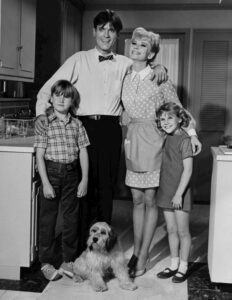
From left: Peter Robbins, Will Hutchins, Patricia Harty and Pamelyn Ferdin with Daisy in a 1968 publicity photo for Blondie. Photo: CBS Television, via Wikimedia Commons.
By the time Fiorello! came along, Harty had a regular job on The Garry Moore Show. E. Thomas Kearney, who guided her early career and whom she later married, encouraged her to take the lower-paying stage job. The original Broadway production lists her as a dancer and as understudy for Dora.
Coward saw her after she moved up in the production and signed her for Sail Away. This time, when the curtain went up on Broadway, the part was hers. She played Nancy Foyle opposite a company that included Elaine Stritch, Alice Pearce and Grover Dale. Coward wrote the book, music and lyrics and directed the show himself.
Harty got a solo in the first act, “Where Shall I Find Him?” Later, she and Dale sang “When You Want Me.” Both performances survive on the original cast recording. For anyone who remembers Harty chiefly as a sitcom actress, that record offers a chance to hear the voice that Broadway audiences knew first.
One performance during the Philadelphia tryout gave her a different kind of solo. A strap on her costume snapped during a dance. Harty excused herself, danced into the wings and came back wearing a man’s sport coat. There was no need to stop the number.
Her Make-Believe Marriage Became a Real One
In 1966, NBC cast Harty and Michael Callan in Occasional Wife. Callan played a bachelor trying to get ahead at a baby-food company whose boss preferred married executives. Harty’s Greta lived upstairs and agreed to pose as his wife when the boss was around. The audience knew the arrangement; the fun was watching the pair try to keep it straight.
What Harty and Callan already shared was a background in dance. Before television, Callan had originated the role of Riff in Broadway’s West Side Story. Both performers had learned how to land a joke or make a moment work with movement, well before a camera brought their faces into close-up.
The series lasted one season. The relationship continued: Harty and Callan married in June 1968, after Occasional Wife had gone off the air. Their marriage ended in divorce in 1970. Harty had previously been married to E. Thomas Kearney, who had helped guide her early career. In 1974, she married producer and assistant director Les Sheldon.
After Blondie, She Found Her Way Back to the Stage
In 1968, CBS gave Harty the title role in Blondie, with Will Hutchins as Dagwood. A publicity photograph from that September shows the whole Bumstead household together: Harty, Hutchins, the two children and Daisy the dog. It’s an easy image to mistake for a family portrait until you read the names. The children were actors Peter Robbins and Pamelyn Ferdin.
Harty continued working on television and also used the professional name Trisha Hart. But the stage hadn’t been merely a way into television for her. In May 1981, two decades after Sail Away, she appeared at Washington’s National Theatre in Neil Simon’s I Ought to Be in Pictures, alongside Bill Macy and Alexa Kenin. She was performing again in the city where she had been born.
Conclusion
If you know Patricia Harty from Blondie, try listening to “Where Shall I Find Him?” from Sail Away. There’s no Dagwood, no sitcom setup, just Harty singing a song Coward wrote for the character she played. It’s a lovely way to hear what that $95-a-week Broadway job eventually bought her: a part of her own.


