

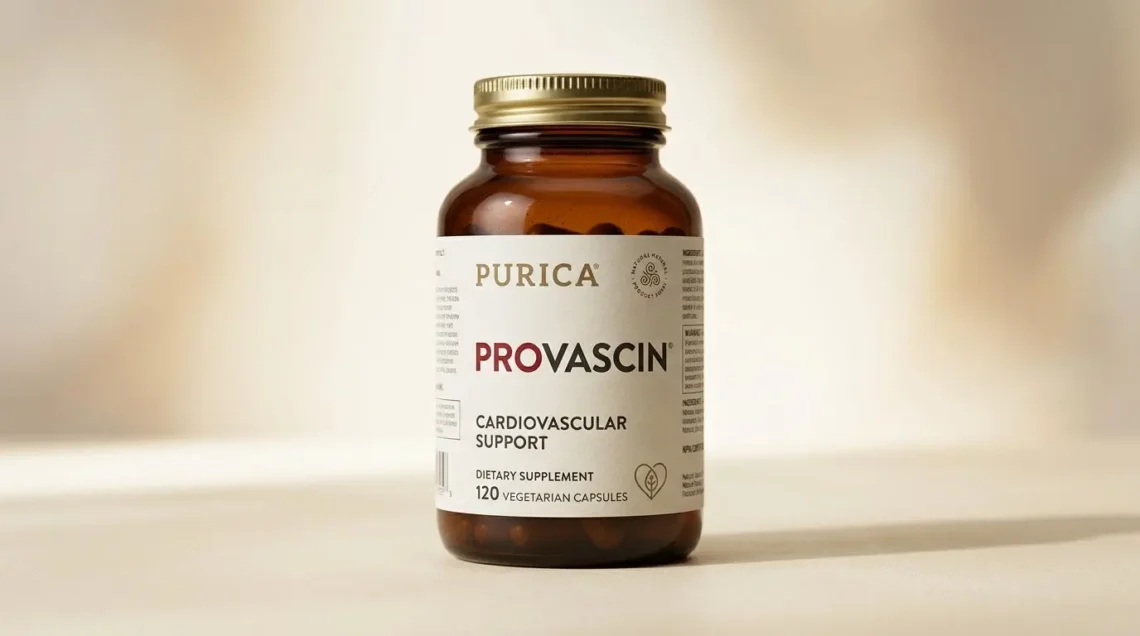
When people search for unfamiliar health products, they often encounter names that sound like prescription medicines. However, not every product associated with heart health belongs to the pharmaceutical category.
Provascin is one example. It was a nutritional supplement associated with the Canadian brand PURICA and marketed primarily for cardiovascular and general wellness support.
The product attracted attention because its formula combined several ingredients associated with cellular energy production and antioxidant activity. These included L-carnitine, Coenzyme Q10, Chaga mushroom, and alpha-lipoic acid.
However, understanding its original purpose requires looking beyond marketing descriptions. Its ingredients do not automatically prove that the complete formula can prevent or treat heart disease.
So, what was Provascin, what did it contain, and what should consumers know about its safety and availability?
This guide examines its historical formulation, intended uses, scientific limitations, and important precautions.
What Is Provascin?
Provascin was a multi-ingredient dietary supplement associated with PURICA, a Canadian natural health brand.
It was sold in capsule form and marketed for cardiovascular wellness, circulation, antioxidant support, and metabolic functions.
Unlike prescription heart medications, the product combined nutritional and botanical ingredients rather than relying on one pharmaceutical active ingredient.
Historical retailer listings identify PURICA as the brand associated with Provascin and show 120- and 240-capsule package sizes.
Importantly, the product name should not be confused with a prescription medicine. Its historical marketing claims do not establish it as an approved treatment for high blood pressure, high cholesterol, or heart disease.
What Was Provascin Used For?
The manufacturer and historical retail descriptions promoted the supplement for several wellness-related purposes.
1. Cardiovascular Support
Heart health was the central focus of its original marketing.
The formula contained ingredients such as CoQ10 and L-carnitine, which participate in cellular energy processes.
These substances have attracted scientific interest because heart muscle requires considerable energy to function.
However, research involving individual ingredients does not establish that the complete supplement improves cardiovascular outcomes.
2. Circulatory Wellness
Historical product descriptions also associated the formula with blood vessel and circulation support.
Some of its ingredients have antioxidant properties, which researchers study in connection with cellular protection.
Nevertheless, there is insufficient direct clinical evidence to establish that Provascin itself improves blood circulation or treats vascular disorders.
3. Antioxidant Support
Antioxidants help protect cells against oxidative damage.
The historical formula included CoQ10, Chaga, grape seed extract, and green tea extract.
These ingredients contain compounds that researchers have studied for their antioxidant properties.
However, antioxidant activity in laboratory research does not automatically translate into proven health benefits in humans.
4. Cellular Energy and Metabolism
L-carnitine and alpha-ketoglutaric acid participate in metabolic processes.
L-carnitine helps transport fatty acids into mitochondria, where cells use them for energy production.
CoQ10 also plays a role in mitochondrial energy production.
These functions explain why the ingredients appeared in a formula marketed around cardiovascular and metabolic wellness.
What Ingredients Did Provascin Contain?
Historical retailer information provides a detailed list of the PURICA formulation.
The following table shows the listed amounts per capsule.
| Ingredient | Amount per capsule |
|---|---|
| L-Carnitine | 188 mg |
| Alpha-ketoglutaric acid | 125 mg |
| Certified organic micronized Chaga | 125 mg |
| Coenzyme Q10 | 38 mg |
| Betaine hydrochloride | 31 mg |
| DL-alpha-lipoic acid | 13 mg |
| Grape seed extract | 9 mg |
| Green tea extract | 9 mg |
The additional ingredients included plant-source magnesium stearate, microcrystalline cellulose, and hypromellose.
These figures describe the historical retailer-listed formula. They should not be assumed to represent every product currently sold under a similar name.
Understanding the Main Ingredients
L-Carnitine: This naturally occurring compound helps transport fatty acids into mitochondria. Researchers have investigated its role in energy metabolism and cardiovascular health.
Coenzyme Q10: CoQ10 participates in mitochondrial energy production and acts as an antioxidant. Researchers have studied its potential applications in several cardiovascular conditions.
Chaga mushroom: Chaga is a fungus used in traditional wellness practices. Its natural compounds have attracted interest in laboratory studies, although strong clinical evidence for cardiovascular benefits remains limited.
Alpha-ketoglutaric acid: This compound participates in the citric acid cycle, an important pathway involved in cellular energy metabolism.
Betaine hydrochloride: This ingredient combines betaine with hydrochloric acid. It is different from simply assuming that all forms of betaine have identical effects.
Alpha-lipoic acid: This compound participates in mitochondrial metabolism and has antioxidant properties.
Grape seed extract: It contains polyphenols, including proanthocyanidins, that researchers study for their biological activities.
Green tea extract: It contains plant compounds called catechins, including EGCG, which have been investigated for antioxidant and metabolic effects.
Does Provascin Actually Improve Heart Health?
This is an important question because supplement marketing and clinical evidence are not the same thing.
Some individual ingredients have been studied in human research. However, there is no established large clinical trial demonstrating that the complete historical Provascin formula prevents heart attacks, treats blocked arteries, or controls hypertension.
The distinction matters.
For example, research involving CoQ10 does not automatically prove that a combination containing CoQ10, Chaga, and several other ingredients produces the same results.
Likewise, laboratory findings about antioxidants cannot establish that a supplement prevents cardiovascular disease.
People with diagnosed heart conditions should rely on evidence-based medical care rather than replacing prescribed treatment with an unproven supplement.
Is Provascin a Prescription Medicine?
No. The best-documented PURICA product was a dietary or natural health supplement, not a prescription cardiovascular medication.
This distinction is important because prescription medicines and supplements have different regulatory requirements.
A product’s classification, permitted claims, and regulatory status depend on the country where it is sold.
Consumers in Canada can check the Licensed Natural Health Products Database to investigate natural health product licences and identify products through their Natural Product Numbers.
For any bottle carrying this name, check the manufacturer, complete ingredient list, dosage information, and regulatory details.
Do not assume that a familiar-sounding product name confirms its medical status.
Safety, Side Effects, and Precautions
A supplement containing several ingredients may create additional considerations, especially when someone already takes medication.
Potential concerns depend on the exact formulation, ingredient amounts, individual health conditions, and other treatments.
Historical PURICA product information included warnings concerning pregnancy, breastfeeding, liver problems, kidney conditions, diabetes, blood pressure medication, and blood-thinning medication.
Chaga products may also require particular caution in people with bleeding risks or kidney-related concerns.
Furthermore, green tea extracts and other concentrated botanical ingredients can differ from the amounts normally consumed through food and beverages.
Before considering any product with this name:
- Check the complete ingredient and dosage information.
- Verify the manufacturer and product authenticity.
- Discuss possible interactions with a pharmacist or healthcare professional.
- Avoid products with unclear labels or unsupported disease-treatment claims.
- Never replace prescribed cardiovascular medication without medical supervision.
The historical formulation does not establish a universal safety profile for every product using the same name.
Is Provascin Still Available?
Availability appears limited.
Vitamart’s historical product listing identifies PURICA Provascin as discontinued and no longer available through that retailer.
Its older 120- and 240-capsule listings remain visible, but the retailer marks them as sold out.
This illustrates an important point: an online product page can remain accessible even after a product leaves a retailer’s active catalogue.
Anyone researching an old bottle should check its expiry date, packaging condition, manufacturer information, and current availability.
Avoid purchasing unidentified or expired supplements from unverified sellers.
Is Provascin the Same as Provasc?
No. Similar spelling does not establish that two products have the same ingredients or medical purpose.
Provascin is associated with a historical PURICA nutritional supplement.
Provascin and Provasc are different names. Similar spelling does not establish that two products have the same ingredients, manufacturer, or medical purpose.
Consumers should always identify a medicine or supplement through its exact active ingredients, manufacturer, and packaging.
Never select a product based only on a similar name.
Conclusion
Provascin was a multi-ingredient dietary supplement associated with PURICA and marketed primarily for cardiovascular and general wellness support.
Its historical formula included L-carnitine, CoQ10, Chaga mushroom, alpha-ketoglutaric acid, betaine hydrochloride, alpha-lipoic acid, grape seed extract, and green tea extract.
Although researchers have investigated several of these ingredients individually, the complete formulation has not been established as a proven treatment for heart disease, high blood pressure, or high cholesterol.
The product also appears to have limited current availability, with at least one major retailer identifying its listing as discontinued.
Ultimately, consumers should distinguish historical marketing claims from clinical evidence and verify the exact product label before considering any supplement.
FAQs
What is Provascin?
Provascin was a nutritional supplement associated with the Canadian brand PURICA and marketed for cardiovascular and general wellness support.
What was Provascin used for?
Its historical marketing focused on cardiovascular wellness, circulation, antioxidant support, and cellular energy metabolism.
Is Provascin a prescription medicine?
No. The documented PURICA formulation was a dietary or natural health supplement rather than a prescription heart medication.
What are the main ingredients?
The historical formula included L-carnitine, CoQ10, Chaga, alpha-ketoglutaric acid, betaine hydrochloride, alpha-lipoic acid, grape seed extract, and green tea extract.
Does Provascin lower blood pressure?
There is insufficient direct clinical evidence to establish that the complete formulation lowers blood pressure. It should not replace prescribed treatment.
Is Provascin still available?
Availability appears limited. Vitamart currently identifies its historical product listing as discontinued and no longer available.
Can Provascin interact with medication?
Potential interactions depend on the ingredients and individual circumstances. People taking blood thinners, blood pressure medication, or diabetes treatments should consult a healthcare professional before considering such supplements.
Is Provascin the same as Provasc?
No. They are different names associated with different products. Always check the actual active ingredients and manufacturer rather than relying on similar spelling.